Untitled(Platform).
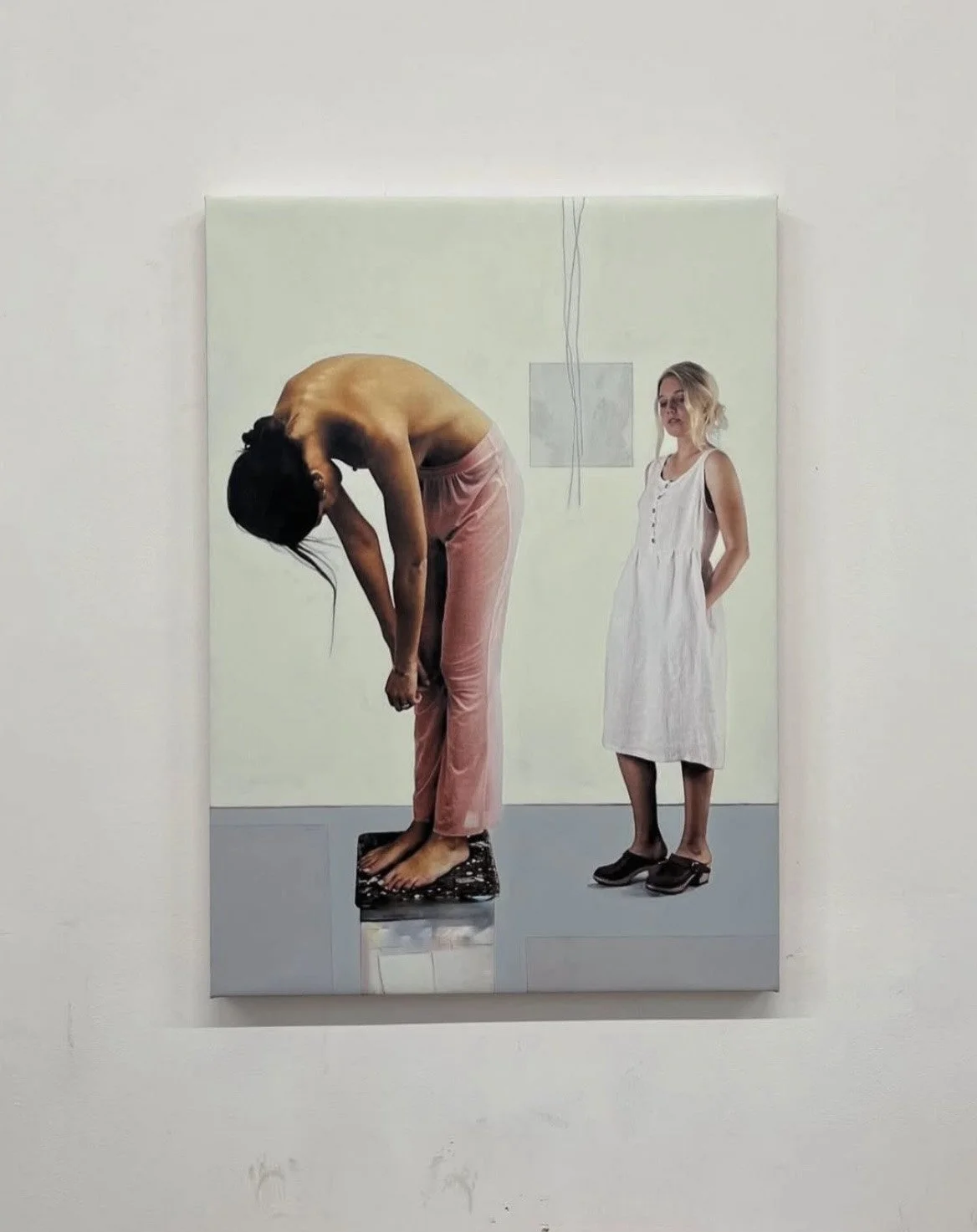
Untitled(Platform).
Acrylic on canvas.
70cm x 50cm.
The title operates as a deliberate double entendre, weaving the physical stage within the painting with the digital platforms that increasingly mediate modern life. Guy Debord’s Society of the Spectacle frames modern existence as one where social relations are mediated by images — where being seen replaces being present, and visibility is mistaken for connection. Here, the platform becomes both stage and cage: it elevates the bowed figure into full view, yet keeps her fixed apart, exposed but unreachable — exactly the paradox of the digital spectacle, where one’s inner life remains invisible even as one’s image circulates widely.
The irony lies in this: the spectacle promises audience and connection, yet delivers only spectatorship. The standing figure does not step forward, does not bridge the gap; she simply observes, steady but removed — mirroring the distance of the gaze online, where we “see” one another yet remain fundamentally separate. The bowed figure does not perform for the view; she turns inward, burdened, unconcerned with how she appears. In a culture that demands we present polished selves, this work centres what the spectacle usually conceals: the weight carried when no performance is offered. The platform, then, is not a place to be seen — but a space where the distinction between being visible and being truly witnessed becomes quietly, unavoidably clear.
Untitled(Office)
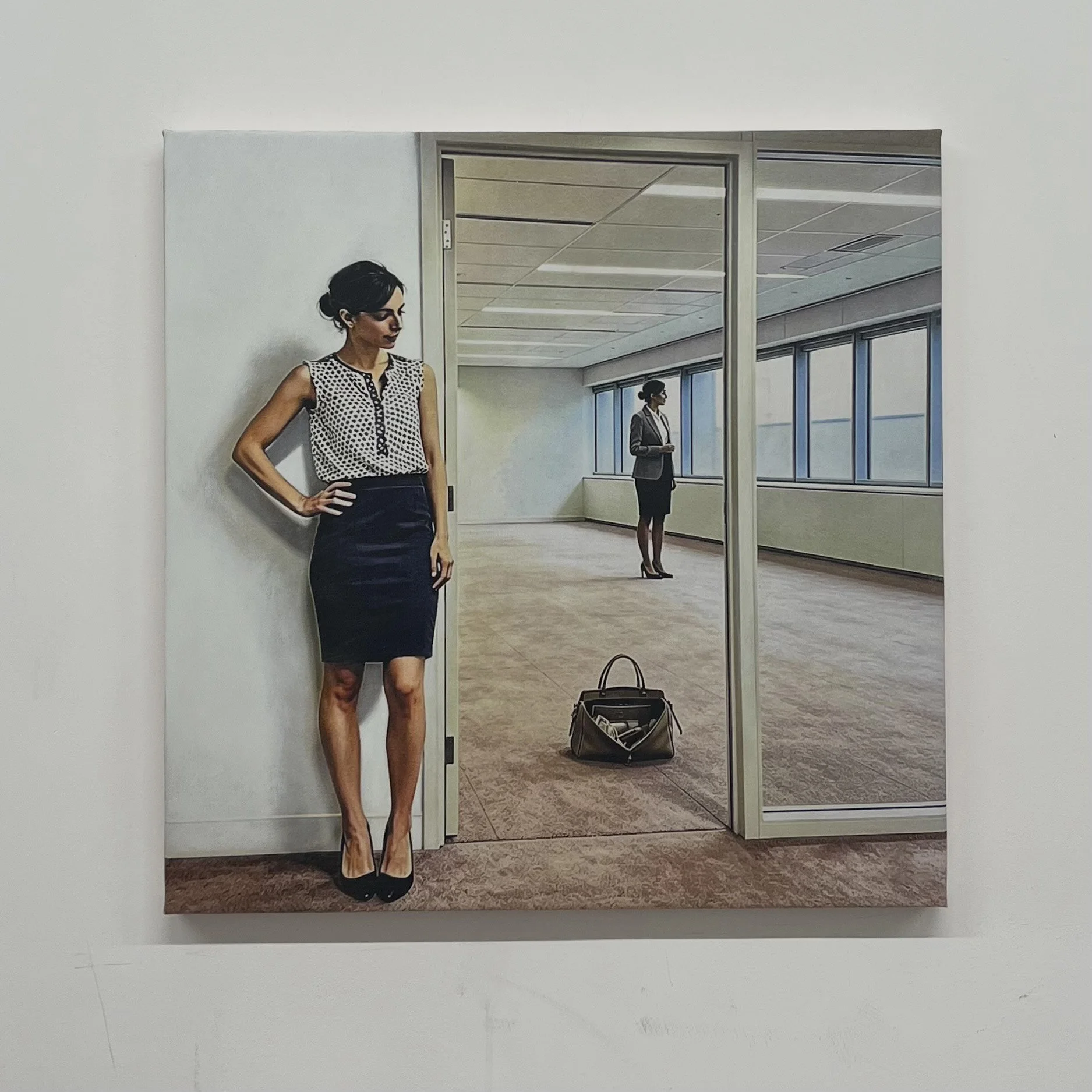
Untitled (Office).
Acrylic on canvas
60cm x 60cm
The painting stages an empty corporate office split by a glass doorway, where one woman leans against the outer wall while a second figure stands far inside the room; an open handbag rests on the floor between them. The space is quiet, brightly lit yet emotionally hollow, a configuration that clearly echoes Edward Hopper’s preoccupation with modern alienation. Where Hopper painted solitary figures sealed inside their own perceptual bubbles, cut off from one another even when sharing the same room, I attempt to literalise that separation through architecture: the glass partition becomes a visible barrier marking the distance between self‑perception and public performance.
The work also speaks to Victor Burgin’s writing on the office as a site of ideological and psychological division. Burgin argues that corporate interiors are not merely neutral backdrops, but symbolic environments that shape how subjects occupy, see, and represent themselves within institutional life. For Burgin, the “other” figure we encounter in such spaces is often not another person, but the version of ourselves we are expected to become. In this canvas the two women may be read as two registers of the same subject: the figure at the threshold hesitates, while the one further inside embodies the professional, constructed self‑the persona demanded by the workplace. The open handbag on the floor, placed precisely at the boundary, becomes a material marker of what remains unshown and unassimilated: the traces of an essential self-left suspended between the outside and the institutional world beyond the glass.
Unlike Hopper, who usually presents alienation as a given condition, and unlike Burgin’s photographic texts which often unpack power through critical narrative, the painting holds the moment open. The painting does not resolve the split, but leaves the threshold itself visible‑a space where the subject has not yet fully stepped into the role assigned to her, nor turned away.
‘Dance first,think later.It’s the natural order.’
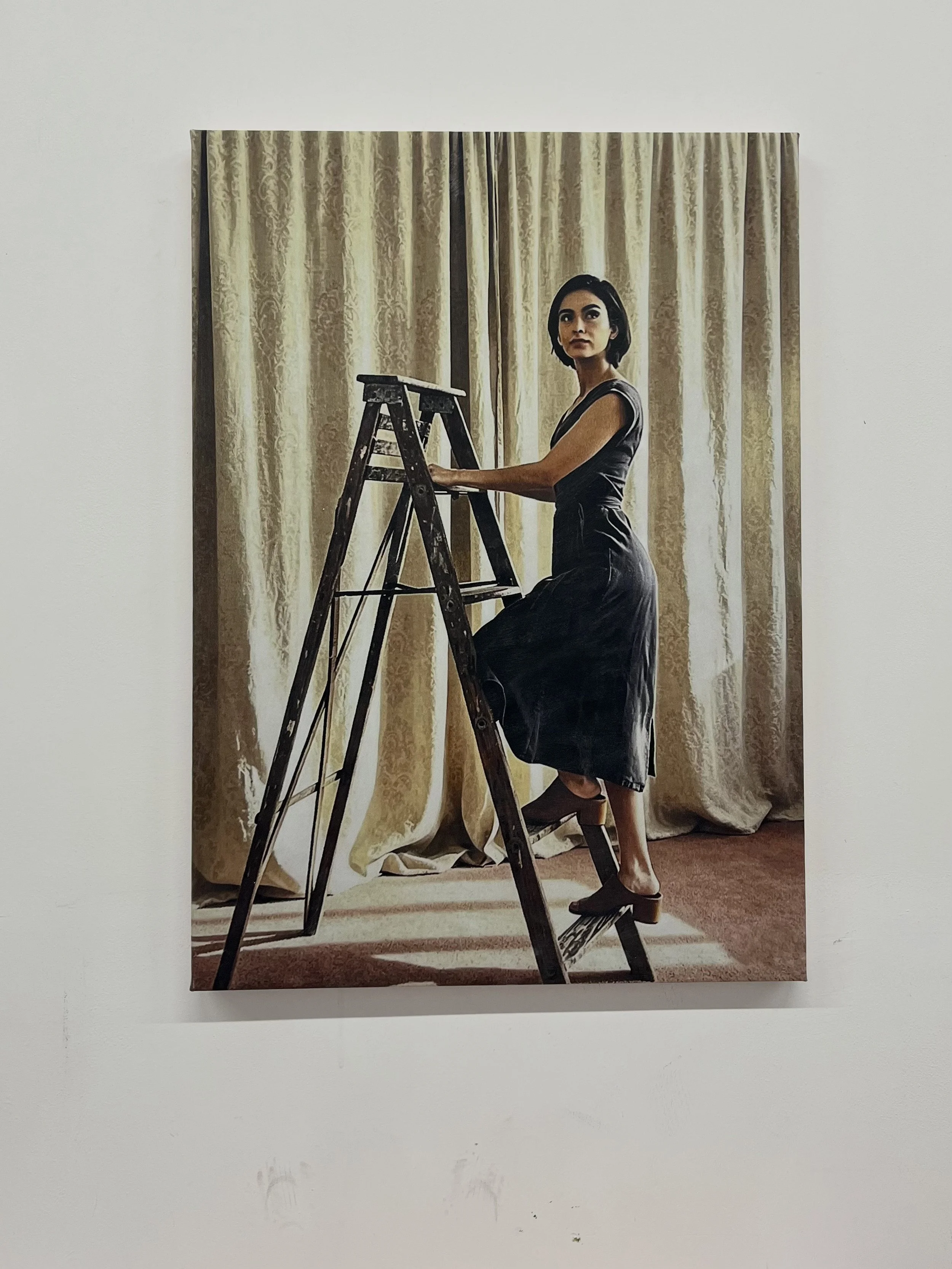
Untitled(Curtain)
Acrylic on canvas.
70cm x 50cm.
This painting depicts a figure positioned centrally within the frame, ascending or poised upon a wooden step-ladder, her gaze directed unflinchingly toward a viewer. Set against the heavy, draped folds of a golden curtain, the image evokes the threshold between backstage and the visible world — a liminal space between private experience and public presentation. The ladder functions here as both literal prop and symbolic device: it suggests elevation, transition, and precariousness, positioning the subject neither fully within one realm nor another, but actively negotiating the boundary between them.
The directness of her gaze disrupts conventional dynamics of viewing. Rather than presenting herself as an object of observation, she asserts reciprocal agency: she who is observed also observes. The curtain, traditionally associated with theatrical revelation or concealment, remains drawn — hinting at what lies behind while framing the subject as both performer and author of her own appearance. In this way, the work engages with questions of representation, selfhood, and the construction of visibility: the figure is not simply seen, but actively claiming her place within the frame, suspended between ascent and arrival, concealment and exposure.
Wet Paint
Thresholds and Oblique Encounters.
Walking the length of Boulevard Beaumarchais — the longest of Paris’s grand boulevards, and arguably its most understated — the Colonne de Juillet rises at its eastern extremity, a monument to the revolutions of 1830 silhouetted against the Parisian sky. This thoroughfare, which I have traversed on innumerable occasions, functions not merely as a route but as a point of entry: a threshold leading into the labyrinthine interior of the Marais, where one might intentionally lose oneself — an act central to the practice of the flâneur that Charles Baudelaire first articulated and Walter Benjamin later theorised as a mode of modern perception.
For Benjamin, the flâneur is both observer and participant, inhabiting the ambiguous space between the crowd and the individual, at home yet forever passing through the city’s streets. It is a figure suspended, as he writes, "on the threshold of the dream world", attentive to the correspondences and echoes that emerge across time and space. This walk, then, is more than physical movement; it is a receptive state — a readiness for what Benjamin called "dialectics at a standstill": those fleeting moments where past and present, image and reality, converge in a single, arresting perception.
Pausing at the Merci bookshop, I encounter a volume bearing André Malraux’s La Métamorphose des dieux. The text advances a thesis: that art outlives its maker, undergoing metamorphosis across time to address successive generations in ways the original creator could never have foreseen. Art, in this conception, is not a static object but a living encounter, perpetually reborn through the gaze of another. Malraux’s reflection aligns closely with Benjamin’s famous contention that the artwork’s significance shifts with each new context and viewer — that there is, in Benjamin’s terms, no single "authentic" meaning, but rather a continuous, evolving history of reception.
Within its pages, an earlier reader has inscribed a reflection upon the figure of the cat — that liminal creature poised between realms: “the fascinating image of the frontier between life and death, a symbol of that perpetual balance between two worlds. The cat stands at the threshold, neither fully here nor there.” This image of the threshold mirrors Benjamin’s conception of the city itself as a space of transitions and boundaries — a place where the visible and the invisible, the remembered and the immediate, constantly bleed into one another. Like the cat, the flâneur occupies this liminal condition: present yet detached, participating yet observing, never fully belonging anywhere.
Moving on, I turn into Rue des Filles-du-Calvaire and stand outside a boutique while my wife and daughter enter. Looking down Rue Debelleyme, a startling recognition unfolds. Before me lies the precise perspective of Balthus’s 1932 painting Le Passage du Commerce-Saint-André. What I behold is not merely a street I know, but its double — an image from elsewhere, returned to the world in another time and place. Benjamin describes such moments as "profane illuminations": those sudden, unexpected flashes of connection where the past illuminates the present, and the present reanimates the past.
This, then, is the oblique connection made tangible. The artwork does not remain confined to the page or the canvas; it seeps into the visible world, forming unscripted correspondences that transcend boundaries. As Benjamin observes, the past does not simply pass away — it continues to interact with the present in unpredictable ways, and it is the task of the flâneur to remain open to these quiet epiphanies. The painting does not simply depict a street; it reconfigures how we see it, creating that void — that receptive space — into which the viewer steps, and from which new possibilities of meaning emerge. To encounter art in this way is to recognise that its work persists — quietly, persistently — long after the hand that made it has fallen still.
https://substack.com/@petermcardleartist/note/c-361645108
Wet Paint
Wet Paint: Rhizomatic Musings from the Studio Chair
Between the material act of painting and what emerges, there lies a space of quiet potential. Wet Paint is for reflection: tentative observations, process-led inquiry, and unstructured thinking from within the studio. Art need not be didactic or pedagogical. Much of its potency, resides instead in a deliberate nothingness—a generative emptiness rather than an absence. The work does not function as a vessel for fixed meaning; rather, it opens itself as a void, a pause, a breathing space into which the viewer, listener, or reader may step freely. In that suspension of certainty, possibilities unfold: not dictated from without, but arising from the encounter itself.
This principle aligns closely with what we might think of as an oblique poetics. Meaning is rarely linear or explicitly declared; connections form tangentially, indirectly, in the manner of the flâneur described by Baudelaire—one who drifts through the visible world without a prescribed route, attentive to the edges and silences between things. The work invites this same drifting: it does not point the way, but offers a threshold across which one may wander, and in wandering, find one’s own way through.
Such an approach also resonates with the concept of the rhizome: an idea that grows outward in multiple directions, with no single origin or predetermined endpoint. Meaning here is not a single thread to be unravelled, but a field of potential connections, continually remade in each engagement. The void at the centre of the work is not empty—it is where the viewer completes the picture, not by solving it, but by inhabiting it.
I will share thoughts on the creative process, the indeterminacy of meaning, and the quiet revelation that occurs when art teaches nothing at all - except how to see more freely.
https://substack.com/@petermcardleartist/note/c-358149618
X – Contemporary British Painting
14 APRIL 2023
Saturday 20th May – Saturday 17th June 2023
X – Contemporary British Painting is a vibrant, exciting free exhibition of painting, the likes of which has not been staged in the North East in decades. Opening on May 20th at Newcastle Contemporary Art, it has been curated by multiple award-winning artist Narbi Price, and brings together the work of over 80 artists. Featuring names such as Andrew Grassie, George Shaw, HUSH, Biggs & Collings alongside members of Contemporary British Painting and recent graduates, the exhibition explores the huge range of possibilities of what painting can be, from photorealism, through gestural abstraction, tiny intimate studies to big bombastic works, paintings that come off the wall and paintings that will make you question what you’re looking at.
Marking the tenth anniversary of CBP, the exhibition features all 6 previous winners of the Contemporary British Painting Prize showing together for the first time. It also showcases former prizewinners of the John Moores Painting Prize, BEEP Painting Biennale, Culture Awards Visual Artists of the Year, and Turner Prize nominees.
Join us on the opening night on Saturday May 20th from 7pm, as part of The Late Shows to be the first to view the work, accompanied by DJ sets by Opal Tapes founder Bishop and Maxïmo Park frontman Paul Smith.
X – Contemporary British Painting
Newcastle Contemporary Art
High Bridge Works
31-39 High Bridge
Newcastle upon Tyne
NE1 1EW
Saturday May 20th – Saturday June 17th
Open Thurs – Sat, 12-5pm and by appointment
Accompanied by a fully illustrated catalogue..
Artists: Susan Absolon, David Ainley, Iain Andrews, Amanda Ansell, John Ball, Richard Baker, Karl Bielik, Biggs & Collings, Claudia Boese, Day Bowman, Marius von Brasch, Julian Brown, Lesley Bunch, Marco Cali, Ruth Calland, Simon Carter, John S Clark, Jules Clarke, Deb Covell, Lucy Cox, Andrew Crane, Gordon Dalton, Pen Dalton, Angelina May Davis, Lisa Denyer, Sam Douglas, Natalie Dowse, Nathan Eastwood, Geraint Evans, Andrew Grassie, Susan Gunn, Susie Hamilton, Abigail Hampsey, Alex Hanna, Kirsty Harris, Roland Hicks, Suzanne Holtom, Marguerite Horner, Barbara Howey, HUSH, Phil Illingworth, Linda Ingham, Brendan Lancaster, Laura Lancaster, Rachel Lancaster, Bryan Lavelle, Andrew Litten, Cathy Lomax, Juliette Losq, Paula MacArthur, David Manley, Enzo Marra, Gavin Maughfling, Peter McArdle, Donna McLean, Monica Metsers, Nicholas Middleton, Ruth Murray, Joe Packer, Stephen Palmer, Mandy Payne, Julian Perry, Ruth Philo, Alison Pilkington, Steve Port, Narbi Price, Freya Purdue, James Quin, Ellen Ranson, Greg Rook, Katherine Russell, George Shaw, Jesse Leroy Smith, Paul Smith, David Sullivan, Matilda Sutton, Harvey Taylor, Sally Taylor, Molly Thomson, Judith Tucker, Casper White, Joanna Whittle, Sean Williams.


LANDMARK PAINTING EXHIBITION TO OPEN IN NEWCASTLE CITY CENTRE
FOR IMMEDIATE RELEASE
X - Contemporary British Painting is a vibrant painting exhibition, the scale of which has not been staged
in the North East in decades.
Opening on May 20th at Newcastle Contemporary Art, X – Contemporary British Painting has been
curated by award-winning artist Narbi Price and brings together the work of over 80 artists, including
George Shaw, Andrew Grassie, HUSH, Biggs & Collings, alongside members of the Contemporary British
Painting organisation (CBP) and innovative emerging artists.
The exhibition explores the huge spectrum what painting can be, from photorealism through gestural
abstraction, tiny intimate studies to big bombastic works, paintings that come off the wall and paintings that
make you question what you’re looking at.
The exhibition marks the tenth anniversary of CBP and features all previous winners of the Contemporary
British Painting Prize. It also showcases prizewinners and nominees of the Turner Prize, the John Moores
Painting Prize, BEEP Painting Biennale, and Culture Awards Visual Artists of the Year.
Join us on the opening night on Saturday May 20th from 7pm, as part of The Late Shows to be the first to
view the work, accompanied by DJ sets by Opal Tapes founder Bishop and Maxïmo Park frontman Paul
Smith.
Exhibiting artists: Susan Absolon, David Ainley, Iain Andrews, Amanda Ansell, John Ball, Richard Baker,
Karl Bielik, Biggs & Collings, Claudia Boese, Day Bowman, Marius von Brasch, Julian Brown, Lesley
Bunch, Marco Cali, Ruth Calland, Simon Carter, John S Clark, Jules Clarke, Deb Covell, Lucy Cox, Andrew
Crane, Gordon Dalton, Pen Dalton, Angelina May Davis, Lisa Denyer, Sam Douglas, Natalie Dowse,
Nathan Eastwood, Geraint Evans, Andrew Grassie, Susan Gunn, Susie Hamilton, Abigail Hampsey, Alex
Hanna, Kirsty Harris, Roland Hicks, Suzanne Holthom, Marguerite Horner, Barbara Howey, HUSH, Phil
Illingworth, Linda Ingham, Brendan Lancaster, Laura Lancaster, Rachel Lancaster, Bryan Lavelle, Andrew
Litten, Cathy Lomax, Juliette Losq, Paula MacArthur, David Manley, Enzo Marra, Gavin Maughfling, Peter
McArdle, Donna McLean, Monica Metsers, Nicholas Middleton, Ruth Murray, Joe Packer, Stephen Palmer,
Mandy Payne, Julian Perry, Ruth Philo, Alison Pilkington, Steve Port, Narbi Price, Freya Purdue, James
Quin, Ellen Ranson, Greg Rook, Katherine Russell, George Shaw, Jesse Leroy Smith, Paul Smith,
David Sullivan, Matilda Sutton, Harvey Taylor, Sally Taylor, Molly Thomson, Judith Tucker, Casper White,
Joanna Whittle, Sean Williams.
Contemporary British Painting is an artist led organisation which explores and promotes current trends in
British painting through the activity of our members, exhibitions, talks and publications, and placing work in
art museums and collections. The group is run entirely by volunteers from within the membership. In 2016
we founded The Contemporary British Painting Prize, an annual prize promoting the best of contemporary
painting produced in the UK.
X - Contemporary British Painting
Newcastle Contemporary Art
High Bridge Works
31-39 High Bridge
Newcastle upon Tyne
NE1 1EW
Saturday May 20th
- Saturday June 17th
Open Thurs - Sat, 12-5pm and by appointment
FREE ENTRY
Interview with Parapluie @ http://parapluieart.com/focus-petermcardle/
Delighted to have participated in this wonderful series of interviews, always insightful and thought provoking. http://parapluieart.com/focus-petermcardle/

Everybody knows this is nowhere ...
Back exhibiting in a physical space. A survey exhibition curated by Dr Narbi Price for Newcastle Contemporary Art, Formerly Baltic 39 .
Everybody Knows This Is Nowhere: Painting in the North East. Now., an exhibition featuring some of the most talented artists currently working in the region, is currently taking place at the North-East’s newest gallery space, Newcastle Contemporary Art. The show has been curated by artist Narbi Price and features work from twelve local artists working in a broad range of styles and forms. A large proportion of the work on display focuses on current events such as the war in Ukraine and the pandemic, as well as concerns changes in culture, advances in technology and isolation.
The artists involved are Mark Bletcher, Rachael Clewlow, Deb Covell, Gordon Dalton, Jonny Green, Oliver Hoffmeister, Rachel Lancaster, Peter McArdle, Narbi Price, Christopher Tansey, Jill Tate and Jonathan West.
The exhibition runs until 9th April and is open Thursday – Saturday (12-5pm) and by appointment from Monday – Wednesday.
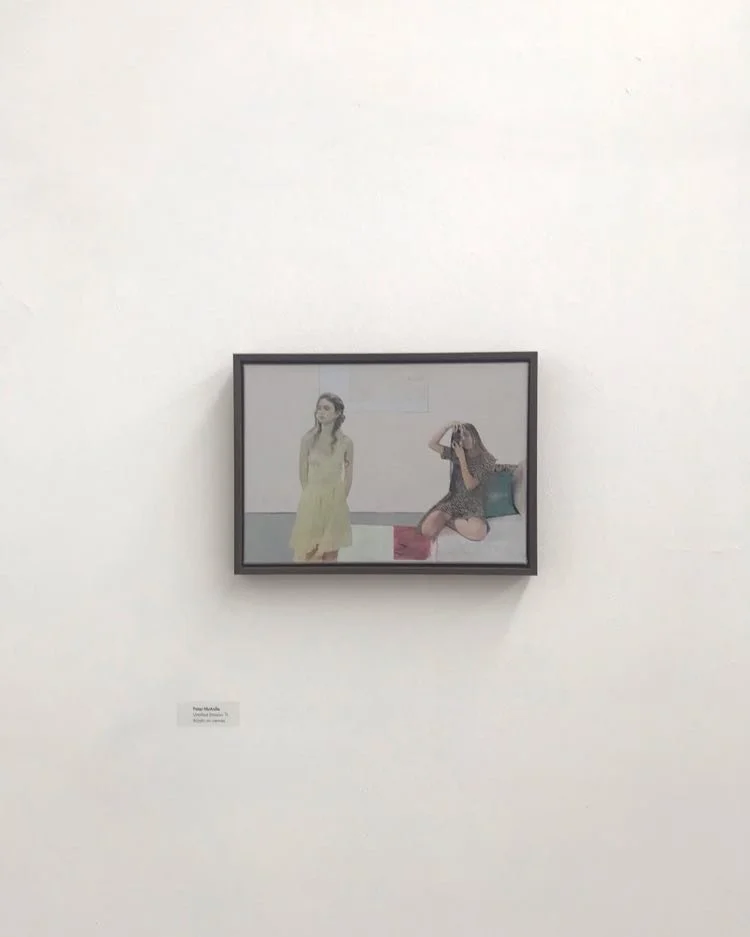


Up & Coming Exhibition......
Everybody knows this is nowhere: Painting in the Northeast now.
OPEN STUDIO . Peter McArdle Artist
An opportunity to meet the artist and purchase direct from the studio. email peter.mcardle2014@gmail.com to arrange an appointment


https://www.saatchiart.com/art-collection/New-This-Week-6-14-2021/153961/616101/view
https://www.saatchiart.com/art-collection/New-This-Week-6-14-2021/153961/616101/view

Interview with Jyoltee Balani https://www.thebestaddress.co/peter-mcardle/
Short interview about my practice https://www.thebestaddress.co/peter-mcardle/


A rhyzomatic visual relationship between two painters R.B.Kitaj and Walter Sickert
Starting a new series of paintings exploring visual relationships between the artists R.B.Kitaj and Walter Sickert.
Untitled (The Front at Hove)


Artist Support Pledge https://artistsupportpledge.com/
I have a number of works available as part of this excellent initiative ..use the contact form for further details .

